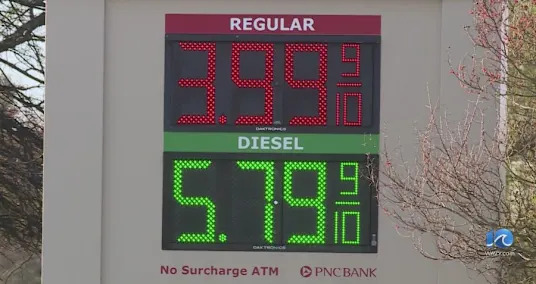
The UK is forecast to experience weaker growth and higher inflation due to the impact of the war in the Middle East, according to an influential global policy group.
It means this year the UK is expected to have the second-highest inflation rate among the G7 group of advanced economies - at 4%, the Organisation of Economic Co-operation and Development (OECD) said.
The body has also downgraded forecasts for many of the world's biggest economies due to the US-Israel war with Iran.
A prolonged conflict could trigger "significant energy shortages" globally, it warned, while if the sharp rise in fertiliser prices is sustained crop yields will be impacted and food prices will soar next year.
The OECD's new forecast for UK inflation is up from the rate of 2.5% it had predicted at its previous report in December.
It then forecasts inflation to drop to 2.6% in 2027 - still up from its previous projection of 2.1%.
Economic growth is now forecast to be 0.7% in the UK this year, down from 1.2% it had previously expected. Its forecast for 2027 is unchanged.
In early March the government's official forecaster, the Office for Budget Responsibility (OBR), cut its expected growth rate for 2026 to 1.1% from the 1.4% it predicted in last year's Budget.
But this forecast was made before the Iran war, which the OBR said could have a "very significant" impact on economies.
Among G7 countries, only the US is predicted to have higher inflation than the UK in the OECD's forecast, while only Italy is expected to see weaker growth.
Global growth is expected to fall to 2.9% this year before nudging up to 3% in 2027. And inflation across the G20 countries is predicted to be 4%, up from previously expected, dropping back to 2.7% next year.
The OECD said its predictions depend on the assumption that the current energy market disruption eases, with oil, gas and fertiliser prices falling from summer onwards.
It said measures from governments to cushion households from the impact of higher energy prices "should be timely, well-targeted on households most in need and viable firms, preserve incentives to lower energy use and have clear expiry mechanisms".
Policies that improve domestic energy use and lower reliance on imported fossil fuels over the medium term were a priority, it added.
The forecast comes as UK clothing retailer Next warned it was likely to have to raise prices for customers if the Iran war persists.
It said overseas sales had been strong up to when the conflict in the Middle East broke out, and instability may continue to restrain growth in that region.
LATEST POSTS
- 1
 Purdue Pharma's deal means money for some victims, end of Purdue company name. Here's what to know
 - 2Famous Network programs in Europe and America
- 3Turning into a Sharp Financial backer: Individual budget Wins
- 4'We were genuinely astonished': This moss survived 9 months outside the International Space Station and could still grow on Earth
- 5Gauging the Upsides and downsides of Visas: A Complete Aide


- 6 Arranging Administrations to Change Your Open air Space
- 41 Young Men Die in South Africa After Circumcision Initiation
- NASA will bring space station crew home early after medical issue
- In blow to Lula, Brazil Congress revives controversial environmental bill
- The World's Dazzling Regular Miracles
- Popular Film Areas: A Worldwide Manual for Film Enchantment
- UAE recalls some Nestle infant formula products, Qatar warns consumers
- A definitive Frozen yogurt Standoff: Which Flavor Rules?
- Pain at the pump for Hampton Roads residents