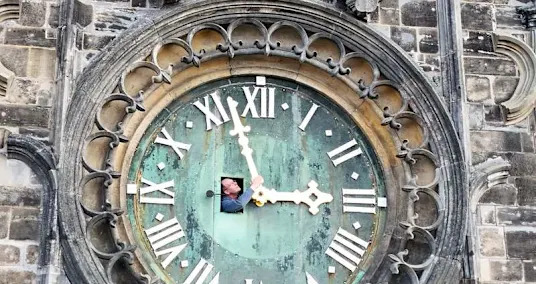
Clocks across the majority of European countries are set to go forward by one hour early on Sunday as the continent moves to daylight saving time, also known as summer time.
Clocks in most European nations including Germany advance by one hour at 2 am (0100 GMT) to 3 am, heralding longer evenings and brighter days.
This means that for the coming months parts of Europe will be on Central European Summer Time (CEST), before moving back to Central European Time (CET) in the autumn, when clocks go back again by an hour on October 25.
The aim of the change is to make better use of daylight in the shorter days of the winter in the northern hemisphere.
The signal for the automatic changeover of the clocks in Germany comes from the Federal Institute of Physics and Metrology (PTB) in the northern city of Braunschweig, also known as Brunswick in English.
The institute's experts ensure that radio-controlled clocks, station clocks and many industrial clocks are supplied with the signal via a long-wave transmitter called DCF77 in Mainflingen near Frankfurt.
LATEST POSTS
- 1
 Are IDF reservists properly armed during post-war operations?
 - 2Instructions to Explore the Universe of Vehicle Leases
- 3What to know about cheese voluntarily recalled in 20 states
- 4Watch interstellar comet 3I/ATLAS make its closest approach to Earth in free livestream on Dec. 18
- 5Big Bear glows with big stars | Space photo of the day for Dec. 31, 2025


- Europe: 4 Urban communities for a Paramount Social Experience
- Pick Your #1 Kind Of Treat
- European Travel Objections for 2024
- At least 7 dead as Israel renews attacks on Beirut and across Lebanon
- The Best Web-based Courses for Expertise Improvement
- Your big brain makes you human – count your neurons when you count your blessings
- ‘Serving is not just a place’: Bayside Church Granite Bay reimagines annual mission amid conflict in Mexico
- NASA releases new ‘Earthset’ and eclipse images taken during historic flyby of the moon
- Sought-After Extravagance Ocean side Objections for a Lovely Escape